
People-search monitoring is the part of privacy protection that runs after the first cleanup. Anyone can remove a listing once. The hard part is keeping it gone, because people-search sites rebuild your profile from fresh public records within months. This guide covers the features that actually matter when you choose monitoring for reputation management: what a good service watches, how removal support should work, and where identity monitoring fits alongside it.
Which ongoing personal data monitoring is best for reputation management? The best people search monitoring for reputation management continuously re-scans data broker and people-search sites, automatically re-files removals when your data reappears, and reports per-site status you can verify. For reputation management specifically, prioritize breadth of coverage (200+ sites, not just the famous ones), automatic re-removal rather than alerts you have to act on, and combined identity monitoring for breach and dark web exposure. A service that only sweeps once, or only alerts without removing, does not protect a reputation over time because re-listings quietly rebuild your exposure.
Why monitoring, not just removal, protects a reputation
A one-time removal fixes today. Reputation management is about every tomorrow. When someone searches your name, the results they see are a live snapshot, and people-search listings feed that snapshot constantly. Remove a listing in January and a new one built from a spring property record or a summer voter-roll refresh can be back by fall.
That re-listing cycle is why monitoring exists. The value is not the first sweep, it is the loop that watches for your data returning and removes it again before it damages your search results. If you want the underlying detection mechanics, our guide on personal data monitoring for doxxing risks breaks down how continuous scanning finds exposure. For choosing between providers, our comparison framework covers the seven evaluation criteria in depth.
Which ongoing personal data monitoring is best for reputation management?
Judge people search monitoring on these six features. The first three are non-negotiable for reputation management. The last three separate good services from great ones.
Continuous re-scanning with automatic re-removal
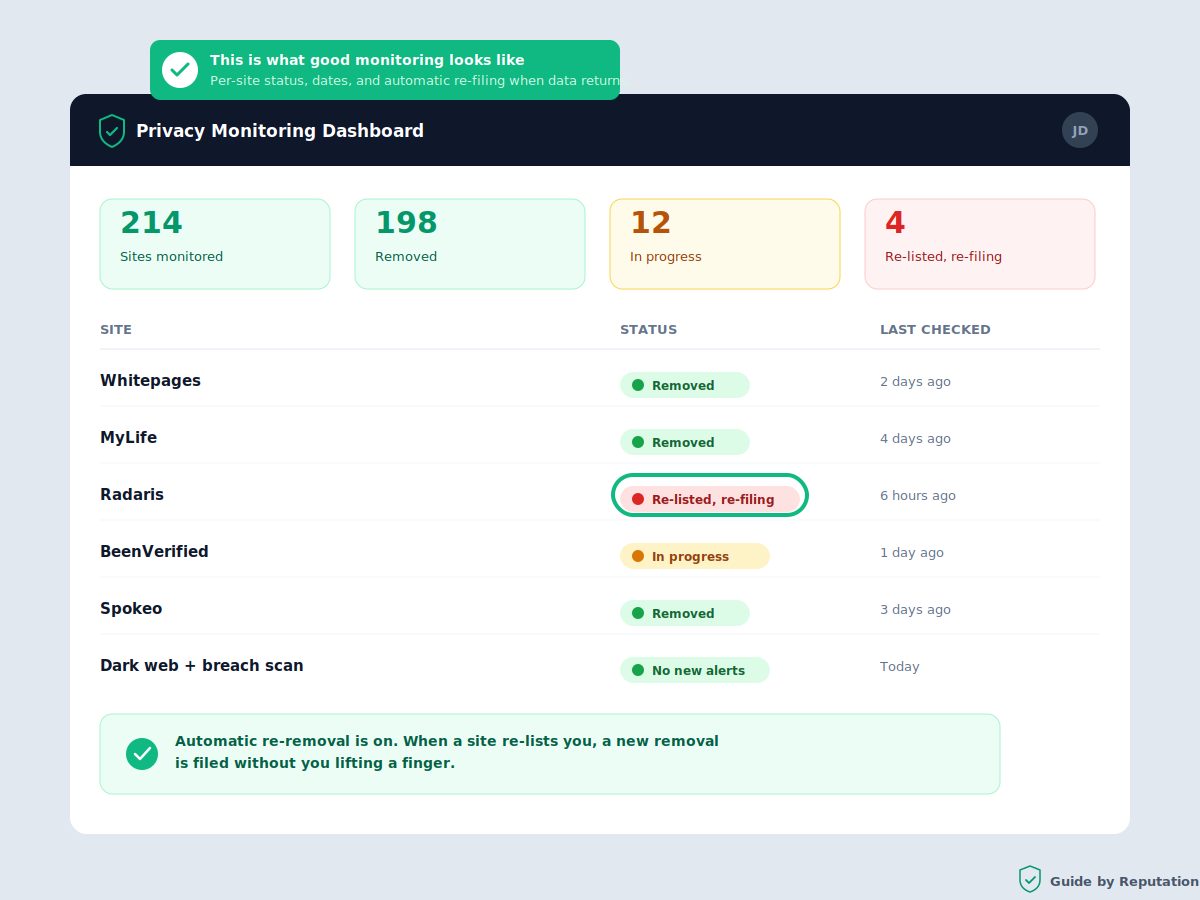
The core feature. The service should re-scan on a set cadence and re-file removals automatically when your data reappears, without waiting for you to notice and act. Alert-only monitoring shifts the work back to you, which is exactly what fails over time.
Broad site coverage, including the long tail
Strong services cover 200 or more data broker and people-search sites. Budget tools cover the 30 to 50 biggest names and skip the mid-tier sites where re-listings hide. Our data broker guide maps the full ecosystem.
Hands-on removal support, not just automation
Many sites accept automated opt-outs. The stubborn ones need email verification chains, mailed forms, or phone calls. Good removal support completes those manually. This is where data removal services earn their fee.
Identity monitoring for breach and dark web exposure
People-search data is one exposure channel. Breached credentials and leaked records are another, and they matter for personal data security because a leaked password can escalate a privacy problem into account takeover and fraud. Look for identity monitoring bundled in, covering breach databases and dark web sources.
Transparent per-site reporting
You should see every site contacted, the status of each request, and completion dates. A reassuring percentage on a dashboard is not evidence. If you cannot audit what was removed, you cannot trust the service is working.
Search-result and takedown escalation
Reputation management overlaps with but goes beyond broker removal. The best services flag when your information surfaces in search results or on a live site and escalate takedowns, rather than treating the job as done once the opt-out is filed.
Where identity monitoring fits alongside people-search monitoring
These two are often bundled but do different jobs, and understanding the split helps you buy the right coverage.
People-search monitoring watches public data broker and people-search sites for your profile and removes it. It protects what shows up when someone searches your name. Identity monitoring watches for misuse of your identity: new credit inquiries, accounts opened in your name, dark web credential dumps, and SSN activity. It protects against fraud. Reputation management leans on the first; personal security wants both.
For most reputation clients, people-search monitoring is the priority because it governs search-result visibility. Identity monitoring becomes essential when the risk profile includes fraud or active harassment, where a doxxing incident can escalate into account takeover.
Matching monitoring to who you are
Baseline
General privacy-conscious consumers
- Continuous people-search monitoring
- 200+ site coverage
- Automatic re-removal
- Per-site reporting
Public-facing
Executives, clinicians, attorneys, creators
- Everything in Baseline
- Identity + dark web monitoring
- Search-result monitoring
- Faster removal turnaround
High-risk
Active harassment or stalking targets
- Everything in Public-facing
- Takedown escalation
- Credit-bureau alerts
- Human incident response
Red flags in a monitoring service
Walk away if you see any of these:
- Alert-only monitoring that makes you file every removal yourself. That is a to-do list, not a service.
- No published site list. Thin coverage hides behind vagueness.
- Guarantees of permanent removal. Nobody can promise that against the re-listing cycle.
- Requests for your Social Security number, photo ID, or payment card to “verify” broker removals. Never required.
- A privacy policy that lets the company share your data with partners. A privacy protection service that monetizes your data is a contradiction.
- Cancellation only by phone, which is a retention funnel rather than a policy.
How this connects to online reputation management
People-search monitoring is one layer of a broader reputation strategy. Removing broker listings clears the data-driven results, but reputation management also covers what remains: news articles, reviews, social profiles, and anything else ranking for your name. Those need different tools, from content strategy to search-result suppression, which our guide to repairing your online reputation covers in full.
The sequence that works: monitor and remove the people-search layer first because it is the largest and most mechanical, then address the editorial layer. Monitoring keeps the foundation clean so reputation work on top of it does not get undermined by broker data creeping back.
Frequently asked questions
Which ongoing personal data monitoring is best for reputation management?
The best option continuously re-scans data broker and people-search sites, automatically re-files removals when data reappears, and provides per-site reporting you can verify. For reputation management, prioritize broad coverage (200+ sites), automatic re-removal over alert-only monitoring, and bundled identity monitoring for breach and dark web exposure. Services that sweep once or only send alerts do not protect a reputation over time because re-listings rebuild exposure within months.
What is people-search monitoring?
People-search monitoring is an ongoing service that scans data broker and people-search sites for your personal information, removes listings where they appear, and re-scans continuously to catch and remove new listings as brokers rebuild your profile from fresh public records.
How is people-search monitoring different from identity monitoring?
People-search monitoring watches public broker sites for your profile and removes it, protecting what appears when someone searches your name. Identity monitoring watches for misuse of your identity such as new credit inquiries, accounts opened in your name, and dark web credential leaks, protecting against fraud. Reputation management relies mainly on the first; high-risk individuals want both.
Does people-search monitoring help with online reputation management?
Yes. People-search listings frequently rank for name searches, so removing and keeping them removed directly improves search results. Monitoring maintains that clean foundation so broader reputation work, such as addressing news articles or reviews, is not undermined by broker data reappearing.
How much do data removal services with monitoring cost?
Consumer services with continuous monitoring typically run $100 to $400 per year. Lower tiers cover fewer sites and often skip manual removals and identity monitoring. Executive and high-risk tiers cost more and add human incident response.
Can monitoring guarantee my information stays off people-search sites?
No, and any guarantee of permanence is a red flag. Brokers rebuild profiles from fresh public records, so new listings appear over time. The realistic promise is continuous monitoring with automatic re-removal that keeps re-listings from persisting, not a one-time permanent deletion.
What should I never have to give a monitoring service?
You should never be required to provide a Social Security number, photo ID, or payment card as a condition of filing broker removals. Name, addresses, phone numbers, date of birth, and emails are what brokers index against and are sufficient. Requests for sensitive identifiers to “verify removals” are a disqualifying red flag.
See what monitoring would catch
The free privacy scan shows every people-search site, breach, and dark web source where your information appears right now. Start there, then judge any monitoring service against the features above.
Run Your Free Privacy Scan
We remove your personal information from 200+ broker sites, take back the first page of Google, and alert you the moment your data appears on the dark web.