
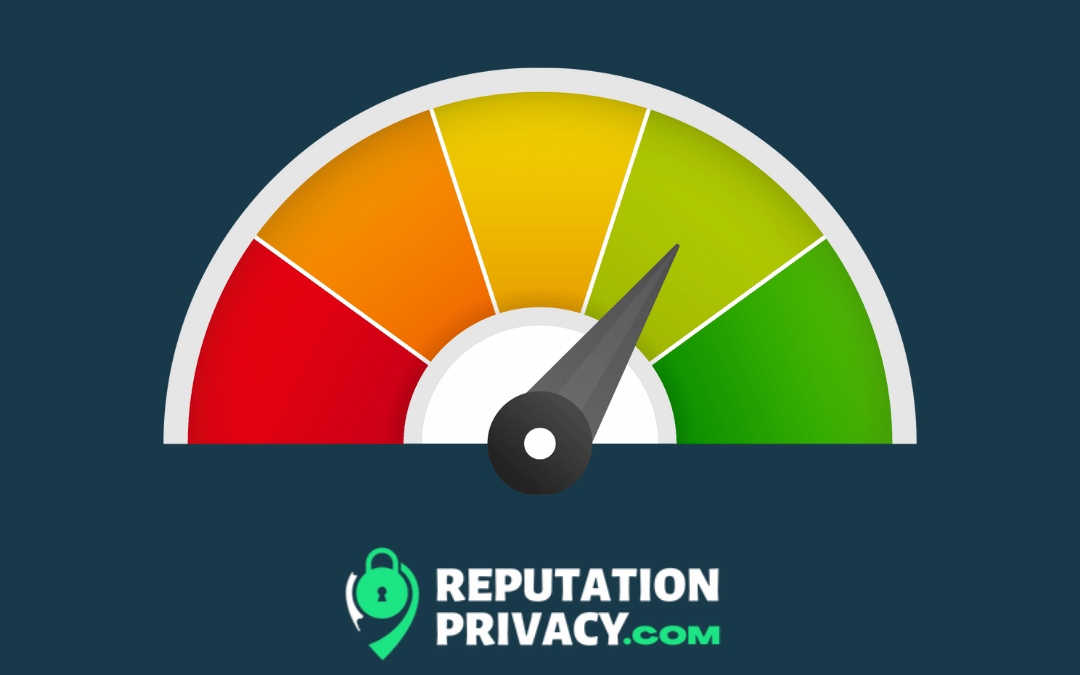
After years of helping people fix what shows up about them online, a pattern became obvious. The same problems came up over and over. The same fixes worked. The hard part was always the diagnosis. People knew something was wrong with their online presence but could not tell you exactly what or how serious it was. So we built a score for it.
The Reputation Privacy Score is a number between 300 and 850 that tells you how strong your online presence is. We modeled the scale after credit scores because most people already understand that range. Lower is risky. Higher is solid. There is a clear way to improve over time.
Why this score exists
Most people do not think about their online reputation until something goes wrong. A job offer gets pulled after the hiring manager Googles you. A new client looks you up and quietly stops responding. A first date disappears after they search your name.
By the time you notice the problem, you have already lost the opportunity, and you usually never find out why. The score is meant to surface what is wrong before that happens, so you can fix it before it costs you something real.
What your score means
The score falls into five tiers. Each tier reflects roughly what a thoughtful person would conclude about you after spending two minutes searching your name.
A low score is not a moral judgment. It means you have gaps that almost anyone in your situation would have if nobody told them where to look. We tell you where.
The three things your score is built from
Three categories drive the score, weighted by how much each one affects what people actually see and decide about you. None of the three works alone. They compound.
1. Personal brand
This is the largest piece of your score. It measures how strong and consistent your public profiles are. A complete, current LinkedIn helps. A polished personal website helps more. A Crunchbase profile that matches what your LinkedIn says, that matches what your company bio says, that matches what your personal site says, helps most of all. Consistency reads as credibility.
We also look at niche platforms relevant to your work. Creative professionals get credit for Behance or Dribbble. Writers and speakers benefit from Medium, Substack, or Quora. Researchers and academics show up on ORCID and Google Scholar. The point is not to be on every platform. The point is to be present and current on the platforms that matter for what you actually do.
If your profiles are outdated, half-built, or wildly inconsistent across sites, that is the fastest place to make up score points. A current photo, a clear bio, and accurate experience across two or three platforms moves most people up a full tier on its own. For the longer version of this work, see our complete guide on repairing your online reputation.
2. Online privacy
Your profiles can look perfect and still not matter if your personal information is published all over people-search sites. Anyone searching your name will scroll past your LinkedIn and find your home address, phone number, the names of your kids, and your estimated income on a site like Spokeo, MyLife, or BackgroundCheck.run.
The privacy section of the score measures how exposed you are on these sites. Every record on a data broker page costs you points. Every removed record adds points back. There are hundreds of these brokers, and a typical American shows up on 80 to 150 of them by default.
You can improve this two ways. The first is to opt out manually, one site at a time. We have written step-by-step guides for the major ones:
- How to opt out of Spokeo
- How to opt out of MyLife
- How to opt out of WhitePages
- How to opt out of BeenVerified
- How to opt out of True People Search
- How to permanently remove yourself from Radaris
- How to opt out of Intelius
The catch is that doing this manually is a part-time job. Every site has a different process, some require notarized forms, and most re-list your data within weeks. For the longer view of this work and why DIY tends to fail by month three, read our walkthrough on the eight steps to erase your digital footprint.
The second way is to let us handle the broker side continuously, which is what most of our customers eventually do.
We also give bonus points for adjacent privacy work: a clean dark web scan, old accounts deleted, your phone number scrubbed from public listings. If you do not know what dormant accounts you still have under your email, start with our guide on finding all accounts linked to your email address. It is often eye-opening.
3. Search engine presence
This is the simplest factor and the one most people focus on intuitively. When someone Googles your name, what do they see?
We look at the first two pages of Google results. Negative content costs you points. Outdated articles cost points. Cases of mistaken identity where someone else with your name did something embarrassing cost points, even though it is not really about you. Mugshots cost a lot of points.
Positive professional results earn points. Your LinkedIn, your company bio, articles you have written or been quoted in, your personal website ranking for your name, image search results that show recent professional photos rather than a 12-year-old Facebook picture. Owning your own knowledge panel in Google is worth real points.
Cleaning up search results is the hardest part of the score to fix because Google moves on its own timeline. But it is fixable. For specific problems, our guides cover the playbook. Start with how to remove a mugshot from Google search if that applies to you. For news articles and editorial coverage you cannot get taken down, see our piece on removing negative news articles.
How the three pieces compound
The factors do not add up. They multiply. A great LinkedIn does not help if your home address dominates page one of Google. A clean Google result does not help if every people-search site still publishes your information. Strong privacy does not help if there is nothing positive about you online for anyone to find when they look.
The score punishes weak links and rewards consistency across all three areas. That is why we built it as one number instead of three separate ratings. People do not interact with your “privacy score” in isolation. They search your name once and form an impression from whatever shows up. The score reflects that single impression.
What an exceptional reputation actually looks like
An 800-plus score is not about being famous. It is about being in control. Someone with a high score has:
- Up-to-date professional profiles that match each other across platforms
- Little to no exposure on data broker sites, plus active monitoring that catches re-listings within days
- First-page Google results that consist entirely of content they would want a stranger to see
- A clear path to find them through legitimate channels and no path to find their home address
- Resilience against any single negative event taking over their search results, because there is so much positive content above and around it
You do not get there overnight. You get there by closing gaps one at a time, in the right order. The score tells you which order.
Where to start if your score is low
If your score is in the Poor or Fair range, work through the list below in order. Most people skip steps because some look more interesting than others. Do not skip steps. The order matters.
- Run a free privacy scan. Find out exactly what is exposed and where. Most people are surprised at how many broker sites have records on them.
- Start opt-outs on the biggest sites. Spokeo, BeenVerified, MyLife, WhitePages, and True People Search account for a disproportionate share of your exposure. Knock these out first using the guides above, or let us handle them.
- Audit your existing accounts. Find and delete the ones you no longer use. Old forum accounts, dead social profiles, abandoned email addresses. Our guide on whether you can permanently delete yourself from the internet covers the realistic version of this process.
- Clean up your active profiles. LinkedIn, your personal website if you have one, your bio on your company site, your social media. Make them current. Make them consistent across platforms. Replace any photos that are obviously dated.
- Address the worst Google results. Mugshots, dismissed legal cases, outdated articles, news mentions that misrepresent who you are now. Some can be removed at the source. Others need to be outranked by better content.
- Set up monitoring. Whatever you fix will erode without it. Brokers re-list data. New articles surface. The score is meant to be tracked over time, not optimized once and forgotten.
One thing to keep in mind. The score updates as your situation changes. Removing your data from a broker site moves the number within days. Suppressing a Google result takes longer because Google’s algorithm needs time to register the change. Be patient with the search component and aggressive with everything else.
Final thoughts
The Reputation Privacy Score is a tool, not a verdict. A low score means you have specific gaps in specific places. It does not mean you have done anything wrong, and it does not mean you cannot fix it. Most of the people we work with started in the Poor or Fair range and moved to Good or Very Good within a few months of focused work.
If you want to see your current score, the privacy scan is free. You can work through the score one piece at a time using the guides on this site, or have us handle the whole process for you. Both paths work. The first one takes longer and requires more patience. Either way, knowing where you stand is the first step.
See your Reputation Privacy Score
The scan is free and takes about two minutes. You will see your current score, what is driving it, and exactly where to start.
Get Your Free Score
We remove your personal information from 200+ broker sites, take back the first page of Google, and alert you the moment your data appears on the dark web.