
Data removal services and personal data monitoring get marketed as the same thing, but they solve different halves of the same problem. Removal takes your information down today. Monitoring keeps it down as it comes back. If you are choosing where to spend your privacy budget to reduce doxxing and identity theft risk, the distinction is the whole decision. This guide draws the line clearly, then shows why the strongest privacy protection uses both.
Personal data monitoring vs data removal services: which is better? Data removal services file opt-out requests to take your information off people-search sites and data brokers, a point-in-time action. Personal data monitoring continuously re-scans those sites and re-removes your data when it reappears, an ongoing process. Removal alone fades because brokers rebuild your profile from fresh public records within months. Monitoring alone without removal just watches the problem. For real doxxing protection and identity theft prevention, you need removal to clear the exposure and monitoring to keep it clear. The best services combine the two: remove once, then monitor and re-remove automatically.
The core distinction in one sentence each
Data removal services
A point-in-time action
- File opt-out requests to people-search sites and brokers
- Clear existing listings from public view
- Deliver a completed-removals report
- Effective the day they run
- Do not, on their own, catch re-listings later
Personal data monitoring
An ongoing process
- Continuously re-scan brokers, breaches, and search results
- Detect when your data reappears or newly appears
- Re-file removals automatically
- Add breach and dark web alerts for identity risk
- Effective over time, not just on day one
Why do privacy services monitor people-search sites so closely?
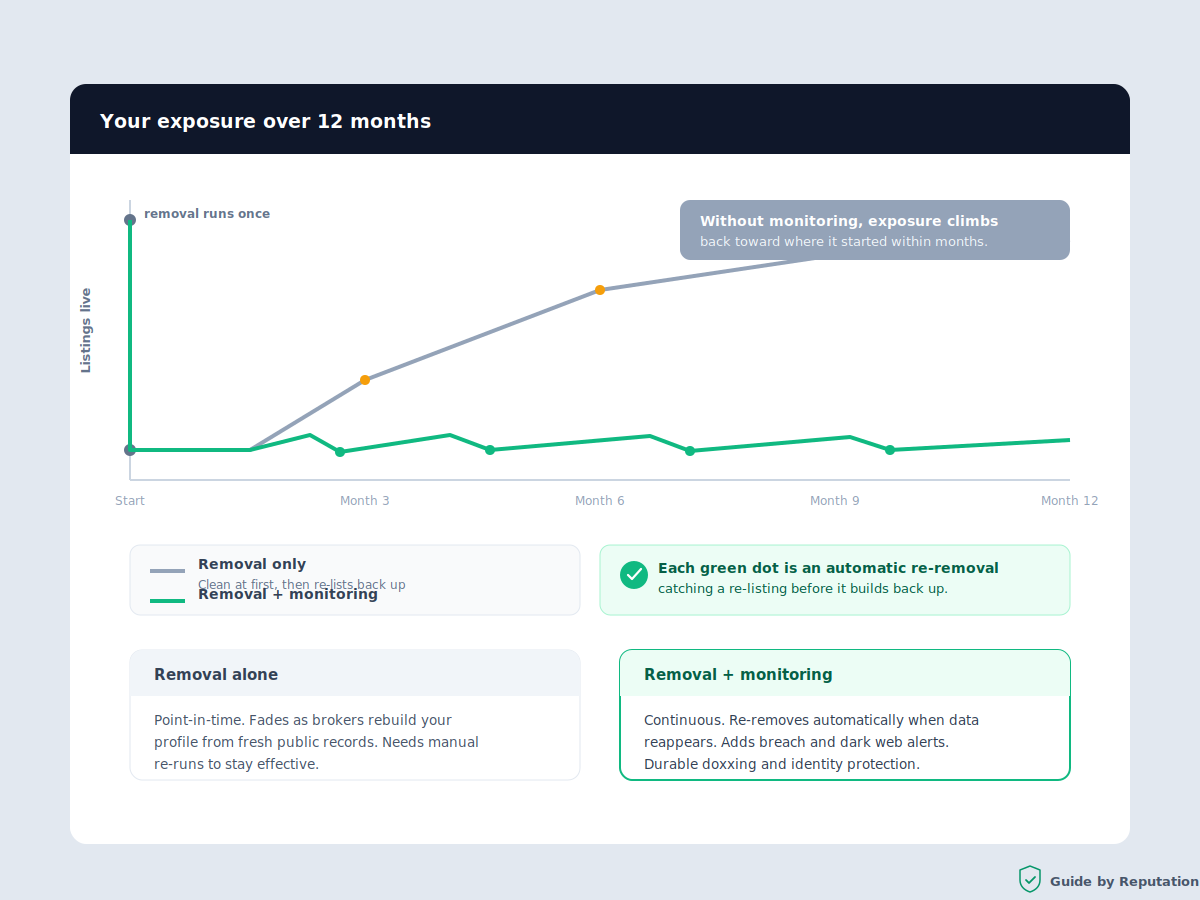
Because people-search sites re-list you. This is the single fact that explains the entire monitoring business. Data brokers continuously ingest fresh public records, so a house purchase, a voter registration update, a new phone number, or a change of address regenerates your profile on sites you were already removed from. Studies of the removal industry consistently find that a large share of removed listings reappear within months.
That means a removal is perishable. Privacy services watch people-search sites closely because the moment they stop watching, the exposure quietly rebuilds. Continuous monitoring of these sites is not an upsell bolted onto removal; it is the only thing that makes removal durable. Our guide on what a data broker is maps where all this data comes from, and our personal data monitoring guide details how detection works.
How do personal data monitoring services help reduce doxxing risks?
Doxxing is a reconnaissance problem. An attacker assembles your address, phone, workplace, relatives, and routine from whatever is publicly findable, and people-search sites are the largest single source of that raw material. Personal data monitoring reduces doxxing protection gaps through a repeating loop:
- Baseline removal. Clear your existing listings so the easy sources go dark.
- Continuous re-scanning. Watch the same sites plus new ones for your data returning.
- Automatic re-removal. Re-file the moment a listing reappears, before an attacker finds it.
- Breach and dark web alerts. Catch leaked credentials that turn a privacy problem into account takeover.
- Search-result watch. Flag when your information surfaces where people actually look.
The reason monitoring matters for doxxing specifically is timing. A one-time removal that lapses leaves a window, and doxxing exploits windows. Monitoring closes the window by keeping the sources dark continuously rather than once. For the incident-response side, our doxxing risk guide covers what to do in the first hours after a dox appears.
Head to head: monitoring vs removal
| Factor | Data removal services | Personal data monitoring |
|---|---|---|
| What it does | Takes listings down now | Keeps them down over time |
| Timeframe | Point-in-time | Continuous |
| Handles re-listings | No, unless re-run | Yes, automatically |
| Doxxing protection | Temporary | Durable |
| Identity theft prevention | Limited | Stronger with breach and dark web alerts |
| Best as | The first pass | The ongoing layer |
The honest takeaway: this is not really an either/or. Removal without monitoring fades. Monitoring without removal just watches. The question is not which to buy, but whether a given service does both well. Most quality services bundle them, so evaluate the bundle, not the label.
Which personal data monitoring services are best for individuals?
Rather than name a single winner (the right answer depends on your risk level and budget), evaluate any service against the criteria that actually separate strong from weak. We cover this in depth in our comparison framework, but the short version for individuals:
- Coverage breadth. 200+ people-search sites and brokers, not just the famous names.
- Automatic re-removal. Re-files without you acting, not alert-only.
- Manual removal support. Completes the sites that need mailed forms or phone calls.
- Identity coverage. Breach and dark web monitoring included for identity theft prevention.
- Transparent reporting. Per-site status you can audit, not a vague percentage.
- Clean data handling. A privacy service that does not sell or share your data.
The major names in this category (DeleteMe, Incogni, Optery, and others including our own service) all cover the basics. They differ on coverage depth, how aggressively they re-scan, whether identity monitoring is included or an add-on, and how transparent their reporting is. Judge them on those axes rather than on marketing claims, and run a free scan first so you are comparing against your actual exposure. Our guide on finding the best removal company walks through vendor evaluation in detail.
Matching the approach to your situation
If you want a one-time cleanup
A removal-only pass (or DIY using our free opt-out guides) works if your exposure is low and you are willing to re-check quarterly yourself. Budget nothing but time, and accept that re-listings will need manual attention. This is a reasonable choice for low-risk individuals with no public profile.
If you want durable online privacy
Combine removal with continuous monitoring. This is the standard recommendation for anyone with a public-facing role or an ongoing concern, because it is the only approach that survives the re-listing cycle without constant manual effort.
If you are managing active risk or a reputation
Full stack: removal, continuous monitoring, identity theft prevention with credit-bureau alerts, and search-result monitoring. When your name is a target or an asset, the monitoring layer is doing reputation management work, protecting what shows up when anyone searches you. Our reputation repair guide covers the editorial layer that sits on top.
Frequently asked questions
What is the difference between personal data monitoring and data removal services?
Data removal services file opt-out requests to take your information off people-search sites and brokers, which is a point-in-time action. Personal data monitoring continuously re-scans those sites and re-removes your data when it reappears, which is an ongoing process. Removal clears existing exposure; monitoring keeps it clear as brokers rebuild your profile from fresh public records.
How do personal data monitoring services help reduce doxxing risks?
They run a repeating loop: remove your existing listings, continuously re-scan people-search sites for your data returning, automatically re-file removals when it reappears, and add breach and dark web alerts. Because doxxing exploits the window a lapsed removal leaves open, continuous monitoring reduces risk by keeping the sources dark over time rather than just once.
Why do privacy services monitor people-search sites so closely?
Because people-search sites re-list people. Data brokers continuously ingest fresh public records, so removed profiles reappear within months when a move, property purchase, or new phone number generates a new listing. Close monitoring is the only thing that makes a removal durable, since the exposure rebuilds the moment monitoring stops.
Which personal data monitoring services are best for individuals?
The best choice depends on risk level and budget, but strong services share the same traits: 200+ site coverage, automatic re-removal rather than alert-only, manual removal support for hard sites, included breach and dark web monitoring, transparent per-site reporting, and a policy against selling your data. Major providers like DeleteMe, Incogni, Optery, and others cover the basics and differ mainly on coverage depth, re-scan frequency, and reporting transparency. Run a free scan first to compare against your actual exposure.
Is monitoring or removal better for identity theft prevention?
Monitoring, because identity theft prevention depends on catching exposure as it happens. Removal reduces the public data available to fraudsters, but monitoring adds breach and dark web alerts that flag leaked credentials and misuse in time to act. For identity protection specifically, the ongoing layer matters more than the one-time pass.
Do I need both monitoring and removal, or just one?
For durable protection, both. Removal without monitoring fades as brokers re-list you. Monitoring without removal just watches the problem without fixing it. Quality services bundle the two: they remove your data once, then monitor and re-remove automatically. Evaluate whether a service does both well rather than choosing between them.
Can I do data removal and monitoring myself?
Yes. Removal is free using published opt-out guides, and basic monitoring is possible with Google Alerts and breach-notification tools. The tradeoff is time: a full first pass takes 25 to 40 hours, plus several hours each quarter to catch re-listings manually. A service automates the re-listing detection and covers the long tail of sites that DIY tends to miss.
How much do these services cost?
Consumer services that combine removal and monitoring typically run $100 to $400 per year. Removal-only or narrow-coverage tiers cost less but skip manual removals and identity monitoring. The free alternative is DIY removal plus manual re-checks. Judge cost against coverage breadth and whether automatic re-removal and identity monitoring are included.
See your exposure before you choose
The free privacy scan shows every people-search site, broker, breach, and dark web source where your information appears right now. Start there, then decide whether removal, monitoring, or both is the right spend for your situation.
Run Your Free Privacy Scan
We remove your personal information from 200+ broker sites, take back the first page of Google, and alert you the moment your data appears on the dark web.