
Doxxing works because your information is findable. Personal data monitoring services shrink that findability by watching broker sites, breach databases, and search results continuously, then removing what they find. The market is now crowded with services that all claim the same thing, and the marketing pages look nearly identical. This guide gives you the comparison framework: the seven criteria that actually separate strong privacy protection from a subscription that quietly does very little.
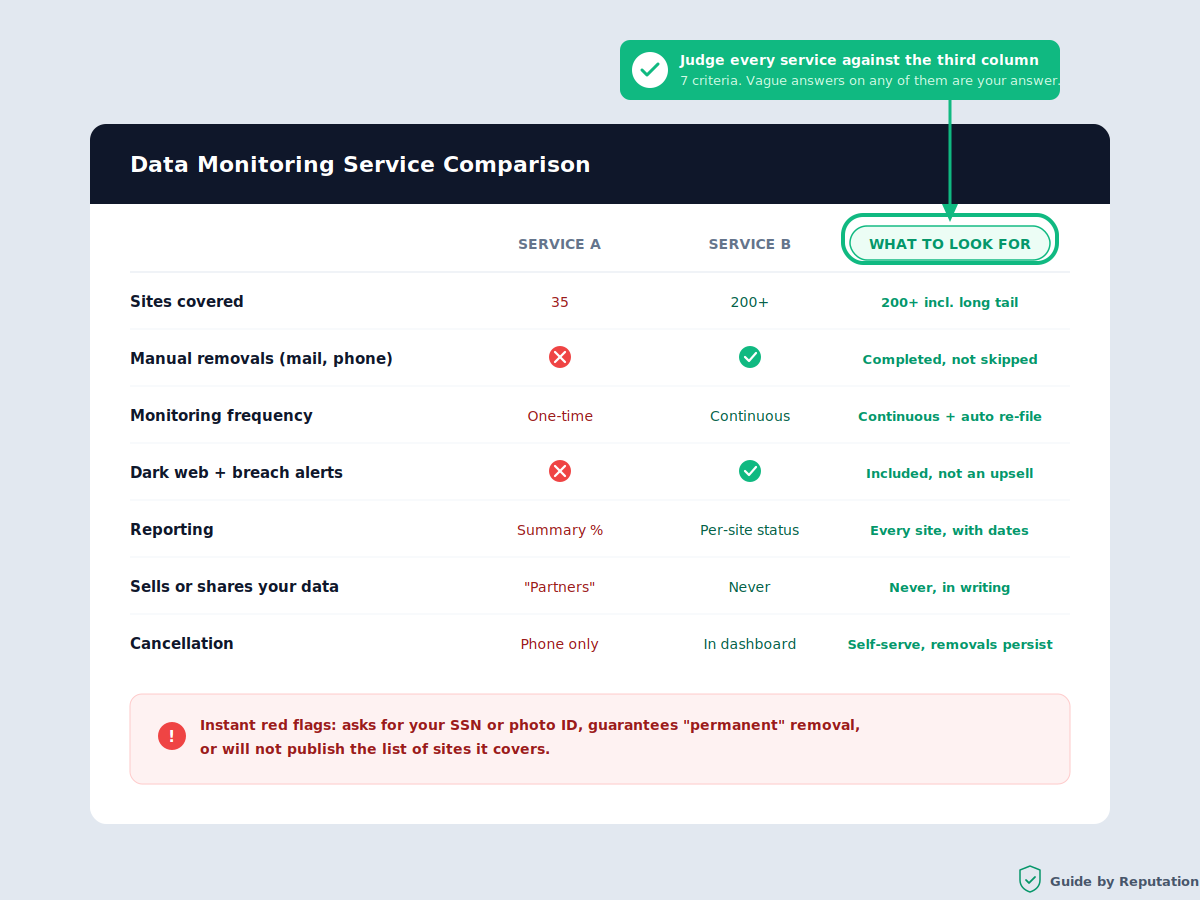
How should I compare personal data monitoring and removal services? Compare personal data monitoring services on seven criteria: coverage breadth (how many broker and people-search sites are scanned), removal depth (automated requests only, or manual work like certified mail and escalation calls), monitoring frequency (one-time sweep versus continuous re-scanning that catches re-listings), dark web and breach coverage, reporting transparency (site-by-site status versus vague dashboards), data handling (whether the service itself sells or shares your data), and pricing terms (contract length, cancellation, what happens to completed removals). The single biggest differentiator is what happens after the first removal pass, because broker sites re-list most people within months.
Why comparison matters: the re-listing problem
Every personal data monitoring service can point to removals it completed. The question that separates them is what happens next. Data brokers continuously ingest fresh public records, so a move, a property purchase, or a voter roll refresh regenerates your profile on sites you were already removed from. Most people drift back toward their original exposure within 6 to 12 months of a one-time cleanup.
That means the value of a service is not the first sweep. It is the monitoring loop: how often it re-scans, whether it catches re-listings automatically, and whether it re-files removals without you asking. A cheap service that runs one pass and a strong service that runs continuously can look identical in month one and completely different in month twelve. If you want the mechanics of how monitoring detects exposure, our companion guide on personal data monitoring for doxxing risks covers the five detection mechanisms in detail.
How should I compare personal data monitoring and removal services?
Use these seven criteria. For each one, there is a specific question to ask the provider (or find in their documentation) before you pay.
Coverage breadth
How many data broker and people-search sites does the service actually scan and remove from? The major players cover 200 or more. Budget services often cover 30 to 50 of the biggest names and skip the long tail, which is exactly where re-listings hide. Our data broker guide maps the full ecosystem so you can sanity-check any coverage list.
Ask: “Can I see the full list of sites you cover, and does it include mid-tier sites and upstream marketing brokers, or only the famous ones?”
Removal depth
Many sites accept automated opt-out requests. The hard ones require email verification chains, notarized forms, certified mail, or phone calls. Services built purely on automation quietly skip those sites because manual work does not scale. People-search site removal that only covers the automated targets leaves your hardest listings untouched.
Ask: “What do you do when a site requires manual verification, mailed forms, or a phone call? Do you complete those, or mark them as unsupported?”
Monitoring frequency
One-time cleanup, quarterly re-scan, or continuous monitoring. Because of the re-listing problem, this is the criterion with the largest long-term effect on your doxxing prevention. Continuous re-scanning with automatic re-removal is the standard to look for.
Ask: “How often do you re-scan, and when you find a re-listing, do you re-file automatically or notify me to act?”
Dark web and breach coverage
Broker sites are one exposure channel. Breached credentials traded on dark web forums are another, and they matter for identity theft protection because leaked passwords enable account takeovers that escalate doxxing into fraud. Some services include dark web monitoring, others treat it as an upsell, and some skip it entirely.
Ask: “Is dark web and breach monitoring included, and does it cover forums and combolists or just publicly disclosed breaches?”
Reporting transparency
Strong services show you every site contacted, the current status of each request, and completion dates. Weak services show a reassuring percentage and a green checkmark. If you cannot verify what was actually removed, you cannot evaluate whether the service is working.
Ask: “Will my dashboard show per-site status with dates, or summary statistics only?”
Data handling and privacy practices
To remove your data, a service needs your data: name, addresses, phone numbers, birth date, emails. Read the privacy policy for what happens to it. A privacy protection company that shares customer data with marketing partners is a contradiction you should walk away from.
Ask: “Is my information used for anything other than filing removals? Is it sold, shared, or used for advertising in any form?”
Pricing terms and exit
Typical online data removal services run $100 to $400 per year. Beyond the number, check contract length, cancellation friction, and what survives cancellation. Completed removals should stay completed; the thing you lose on cancel is future monitoring.
Ask: “Is there a contract? Can I cancel from the dashboard without a phone call? What happens to completed removals if I cancel?”
DIY versus a service: the honest math
You can do everything a service does yourself. Every opt-out in our library, from Whitepages to MyLife to BeenVerified and Radaris, is free and documented. The comparison is time versus money:
DIY removal and monitoring
- Free, apart from your time
- 25 to 40 hours for a full first pass
- 5 to 8 hours per quarter to maintain
- Google Alerts and Have I Been Pwned for basic monitoring
- No dark web forum coverage
- Re-listings caught only when you manually re-check
Personal data monitoring services
- $100 to $400 per year typical
- 200+ sites covered including the manual-work ones
- Continuous re-scanning and automatic re-removal
- Dark web and breach monitoring included or available
- Per-site reporting you can audit
- Takedown escalation when active doxxing appears
A reasonable middle path: run our free scan (or any service’s free assessment) to see your actual exposure, handle the top 5 to 10 sites yourself using the guides, and decide whether the remaining long tail plus ongoing maintenance is worth outsourcing. Our guide on finding the best removal company goes deeper on vendor evaluation.
Red flags that disqualify a service
Walk away if you see any of these:
- Requests for your Social Security number, photo ID, or payment card “to verify removals.” Broker opt-outs do not require any of those.
- Guarantees of permanent removal. Nobody can promise permanence against the re-listing cycle, and honest services say so.
- No site list published. If they will not tell you what they cover, assume the coverage is thin.
- Cancellation only by phone. That is a retention funnel, not a policy.
- A privacy policy that permits sharing customer data with “partners.” The business model contradicts the product.
- Claims of removing court records, news articles, or government records through the same opt-out pipeline. Those are separate legal processes, and bundling them into broker-removal marketing is a sign of overpromising. For search results specifically, that work falls under reputation management, which is a different discipline with different timelines.
Matching the approach to your risk level
Low risk: general privacy hygiene
No specific threat, no public-facing role. DIY the top sites, set Google Alerts on your name, check Have I Been Pwned twice a year. Upgrade to a service if maintenance keeps falling off your list.
Medium risk: public-facing work or prior incidents
Healthcare workers, attorneys, teachers, executives, anyone with an audience. Use a service with continuous monitoring and dark web coverage. The re-listing loop is the threat, and you will not out-discipline it manually forever.
High risk: active harassment, stalking, or doxxing
Full stack: continuous monitoring, dark web and breach alerts, identity theft protection with credit-bureau alerts, and takedown escalation. Move fast on the first pass, and read our doxxing response playbook for the incident-handling side, including what to do in the first hours after a dox appears.
The decision checklist
Before you pay for any personal data monitoring service, you should be able to answer yes to all seven:
- I have seen the full list of covered sites, and it includes more than the famous names.
- The service completes manual removals (mail, phone, notarized forms), not just automated ones.
- Monitoring is continuous, and re-listings are re-filed automatically.
- Dark web and breach monitoring is included or available at a price I accept.
- The dashboard shows per-site status with dates.
- The privacy policy prohibits selling or sharing my data.
- I can cancel from the dashboard, and completed removals survive cancellation.
Any provider worth paying should pass all seven without hedging. If a sales page or support conversation gets vague on criteria 2, 3, or 6, that vagueness is your answer.
Frequently asked questions
How should I compare personal data monitoring and removal services?
Compare on seven criteria: coverage breadth (how many broker sites are scanned), removal depth (whether manual removals like certified mail and phone calls are completed), monitoring frequency (continuous re-scanning versus one-time sweeps), dark web and breach coverage, reporting transparency (per-site status versus summary dashboards), data handling (whether the service sells or shares customer data), and pricing terms (contracts, cancellation, what survives cancellation). The largest long-term differentiator is what happens after the first removal pass, because brokers re-list most people within months.
What do personal data monitoring services actually do?
They scan data broker sites, people-search sites, breach databases, dark web sources, and search results for your personal information, file removal requests where your data appears, and re-scan continuously to catch re-listings. Stronger services also complete manual removals, provide per-site reporting, and escalate takedowns when active doxxing appears.
How much do personal data monitoring services cost?
Consumer services typically run $100 to $400 per year. Lower-priced tiers usually cover fewer sites and skip manual removals and dark web monitoring. Executive-protection tiers cost more and add human incident response. The free alternative is 25 to 40 hours of DIY work plus 5 to 8 hours per quarter of maintenance.
Does data removal actually reduce doxxing risk?
Yes. Doxxing depends on reconnaissance, and broker sites are the largest single source doxxers use to assemble address, phone, family, and workplace details. Removing that data raises the effort required dramatically, and most casual harassers give up when the easy sources go dark. Monitoring keeps the sources dark as brokers re-list.
What is the difference between data monitoring and identity theft protection?
Data monitoring watches public and dark web sources for exposure of your personal information. Identity theft protection watches for misuse: new credit inquiries, accounts opened in your name, address changes, and SSN activity. They overlap when a doxxing incident escalates into fraud, and high-risk individuals typically want both.
Can a service guarantee permanent removal from people-search sites?
No, and a guarantee of permanence is a red flag. Brokers rebuild profiles from fresh public records, so new listings appear over time regardless of past removals. The honest promise is continuous monitoring with automatic re-removal, not permanence.
Should I do data removal myself or pay a service?
Both work. DIY costs 25 to 40 hours up front plus quarterly maintenance and covers the automated opt-outs well. A service earns its fee on the long tail of sites, the manual removals, continuous re-listing detection, and dark web coverage. A common middle path: DIY the top 5 to 10 sites using free guides, then decide whether the rest is worth outsourcing.
What information do I have to give a monitoring service?
Name, current and past addresses, phone numbers, date of birth, and emails, because that is what brokers index against. You should never be asked for a Social Security number, photo ID, or payment card as a condition of filing removals. Requests for those are a disqualifying red flag.
Start the comparison with real data
The free privacy scan shows every broker site, breach, and dark web source where your information appears. Run it first, then judge any service, including ours, against the seven criteria above.
Run Your Free Privacy Scan
We remove your personal information from 200+ broker sites, take back the first page of Google, and alert you the moment your data appears on the dark web.